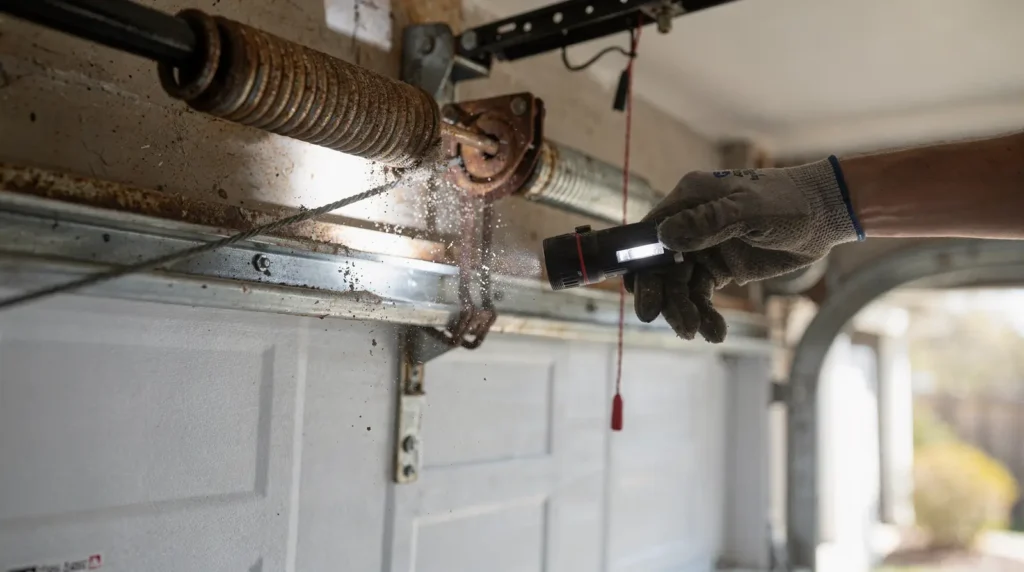
Garage door springs break prematurely from metal fatigue caused by repeated tension cycles, typically 10,000 openings and closings. Corrosion from Sacramento’s humidity accelerates wear, while misaligned tracks or unbalanced doors add stress. Most springs snap when the door is fully closed, where tension peaks. Professional inspection catches early warning signs.
Key Takeaways
Metal fatigue from repeated tension cycles causes springs to break, typically after 10,000 openings and closings.
Sacramento’s humidity and temperature fluctuations accelerate corrosion, creating microscopic cracks that spread until failure occurs.
Spring tension peaks when the door is fully closed, making that position the most common failure point.
Misaligned tracks, unbalanced doors, and skipped maintenance force connected components to work harder, accelerating deterioration.
Why Do Garage Door Springs Break?
Garage door springs fail when accumulated stress exceeds the metal’s fatigue limit. Most springs break in the fully closed position because spring tension reaches its absolute peak at that point. Homeowners who ignore early warning signs risk complete system failure and a door that refuses to open.
The root cause traces back to how these components function. Garage doors are heavy. Springs counterbalance that weight so the opener does not perform the full lift. This constant load-bearing role subjects springs to relentless wear. Springs wear down quietly over time. Small factors like rust, temperature swings, and missed maintenance speed up the deterioration process considerably.
Sacramento’s climate adds another layer of risk. Temperature fluctuations cause metal to expand and contract repeatedly. Moisture from seasonal rains introduces rust. Without regular lubrication and inspection, springs degrade faster than expected.
What Happens When Springs Are Worn?
Worn springs force every connected component to work harder. The opener strains beyond its designed capacity. Cables, rollers, and tracks absorb extra friction. The door itself experiences uneven stress distribution. Broken garage door spring signs often appear long before total failure, including loud operation and jerky movement.
Can Rust Alone Cause a Spring to Snap?
Rust does more than create surface blemishes. It pits the metal and creates weak points. When high-tension steel develops corrosion damage, microscopic cracks form. These cracks spread with each cycle until the spring fractures suddenly. The loud bang Sacramento homeowners sometimes hear originates from this catastrophic release of stored energy.
Overhead Door Company of Sacramento Inc. has serviced broken springs since 1953. The company’s technicians inspect the full system rather than replacing springs in isolation. Addressing one worn component without checking cables, rollers, and opener strain leaves the door vulnerable to repeat failure.
What Causes Garage Door Springs to Break or Wear Out Prematurely?
Garage door springs counterbalance hundreds of pounds of steel every time the door opens and closes. Spring failure rarely happens without warning. Gradual wear, environmental factors, and skipped maintenance quietly degrade these components until they snap, often with a startling bang that signals the lifting spring has broken in half.
Most garage door spring failures are not truly sudden events. Springs wear down over time. Rust, temperature swings, and missed maintenance accelerate the deterioration. Homeowners who understand the root causes can spot trouble before a complete failure leaves a garage door inoperable.
Why do torsion springs fail earlier than expected?
Torsion springs mount above the door opening and twist under tension to lift the weight. Extension springs stretch along the horizontal tracks. Both systems have a finite service life measured in cycles, not years. One open-and-close sequence equals one cycle. Standard springs typically last 10,000 cycles. Heavy daily use consumes that lifespan faster than most homeowners realize.
What role does rust play in spring breakage?
Rust creates microscopic pits on the spring coil surface. These pits become stress concentration points. Each cycle flexes the metal at those weakened spots. Eventually a crack forms and propagates until the spring snaps. Sacramento’s dry summers help, but winter moisture and coastal humidity from nearby Fairfield or Davis still introduce corrosion risk. Regular lubrication forms a protective barrier against this damage.
Can temperature changes cause springs to break?
Metal expands and contracts with temperature shifts. Repeated thermal cycling stresses the spring material at a molecular level. Cold mornings make the metal more brittle. A spring already near the end of its cycle life faces higher failure risk during Sacramento’s cooler winter months. The combination of age, rust, and temperature stress creates conditions where breakage becomes nearly inevitable.
Torsion springs and extension springs differ in mounting location and operational style. Torsion systems sit above the door on a header bracket. Extension systems mount on both sides of the door tracks. Each type demands specific inspection routines. Overhead Door Company of Sacramento technicians assess both systems during service calls across Roseville, Rocklin, and surrounding communities.
Why Is DIY Spring Repair Dangerous?
Garage door springs store massive mechanical energy. That stored force makes amateur repair attempts extremely hazardous. When a spring snaps, the sudden release of tension can cause severe injury or property damage. Most springs break when the door is fully closed because spring tension peaks at that position.
Homeowners often underestimate the danger. A single torsion spring holds enough energy to lift a 200-pound door. That energy does not disappear when the spring breaks. It waits for an unsuspecting person to release it incorrectly.
What Makes Garage Door Springs So Dangerous to Handle?
The tension in a garage door spring is not like a typical household repair hazard. What causes garage door springs to break or wear out prematurely is one concern. The greater concern is what happens when an untrained person tries to fix one. Specialized winding tools and professional training are absolute requirements. Standard wrenches and screwdrivers cannot safely control the stored force.
Can a Broken Spring Still Cause Injury?
A broken spring remains dangerous. The intact sections still hold tension. One wrong move with a pry bar or an improvised winding tool can send metal fragments flying. The spring can also slip and strike hands, arms, or the face. These injuries are not minor. Emergency room visits from garage door spring accidents often involve fractures and deep lacerations.
Professional intervention eliminates these risks. Overhead Door Company of Sacramento sends trained technicians who wear uniforms and drive fully equipped company trucks. The company is insured and bonded, providing additional protection for every repair job. Homeowners who attempt DIY spring work forfeit that safety net. The cost of a hospital visit far exceeds the cost of professional service. A safer path exists. Homeowners can review guidance on how to fix a garage door spring safely to understand the complexity before deciding to call a professional.
How Can Routine Maintenance Extend Spring Life?
Routine maintenance directly extends garage door spring life by catching wear before catastrophic failure occurs. Professional tune-ups address the root causes of premature spring breakage, including rust accumulation, friction damage, and improper tension calibration.
Sacramento homeowners face unique challenges. Temperature swings and seasonal humidity accelerate metal fatigue in torsion and extension springs. Without consistent care, springs lose their rated cycle life. A spring rated for 10,000 cycles might fail at 7,000 cycles when neglected. That gap represents years of lost service.
What Does a Professional Spring Tune-Up Include?
A qualified technician performs several critical checks during a maintenance visit:
Lubrication of coils and pivot points to reduce friction and heat buildup
Balance testing to confirm both springs carry equal load
Visual inspection for rust, gaps, or deformation in the coil windings
Tension adjustment to compensate for natural spring settling over time
Each step prevents the uneven stress that accelerates metal fatigue. Springs operating under balanced tension wear evenly across their entire length.
How Often Should Garage Door Springs Be Serviced in Sacramento?
Annual inspections catch developing problems before springs snap. Homes with heavier doors or high-cycle daily use benefit from twice-yearly checks. The company providing service since 1953, Overhead Door Company of Sacramento Inc., offers sales, service, and installation for both residential and commercial garage doors. Its technicians understand how local climate conditions affect spring longevity.
A comprehensive garage door spring maintenance program includes lubrication, hardware tightening, and cycle-count tracking. These steps preserve the spring’s engineered lifespan. When springs do eventually wear out, the company provides 24/7 emergency repair services. As the only authorized Overhead Door distributor in Sacramento, Placer, Yolo, Solano, Yuba, El Dorado, Amador, Nevada, and Sutter counties, it maintains direct access to factory-spec components. Proper parts and precise installation prevent the premature failures that generic replacements often cause.
FAQ
Why do garage door springs break prematurely?
Garage door springs break from metal fatigue after roughly 10,000 open-close cycles. Corrosion from Sacramento’s humidity, misaligned tracks, and unbalanced doors accelerate wear, with most springs snapping when the door is fully closed.
What role does Sacramento’s climate play in spring failure?
Sacramento’s humidity and temperature swings cause metal to expand and contract, introducing rust. Corrosion pits the steel, creates microscopic cracks, and spreads until the spring fractures suddenly.
How does a worn spring affect the rest of the garage door system?
A worn spring forces the opener, cables, rollers, and tracks to work harder, adding friction and uneven stress. Overhead Door Company of Sacramento technicians inspect the full system to prevent repeat failures.
Conclusion
Premature garage door spring failure stems from metal fatigue, corrosion, temperature stress, and unbalanced door systems, all preventable through routine professional maintenance. Understanding these root causes underscores why DIY repair attempts pose serious safety risks and why annual inspections from qualified technicians protect both your investment and your family. The path forward is clear: schedule professional service to extend spring life, ensure balanced operation, and eliminate the hazards associated with stored mechanical energy. Call Overhead Door Company of Sacramento today to schedule a professional spring inspection and keep your garage door operating safely.