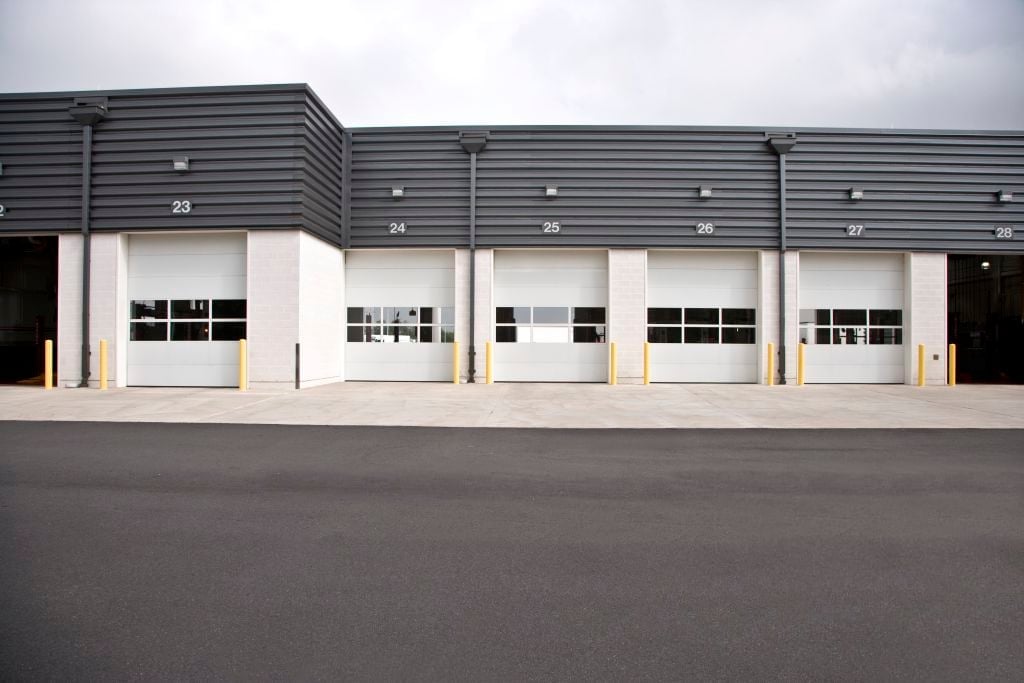
Commercial facility managers comparing industrial garage doors must evaluate rolling steel, sectional, and high-speed models. Overhead Door™ Company of Sacramento offers the industry’s most comprehensive line, including Thermacore insulated doors for energy efficiency and fire-rated doors for safety compliance. Each solution prioritizes durability, security, and customizable performance for demanding commercial environments.
Key Takeaways
Rolling steel doors coil into a compact barrel assembly above the opening, conserving ceiling space and side room.
Sectional doors outperform rolling doors when climate control matters, with insulated panels reducing thermal transfer.
High-speed doors open and close rapidly, reducing wait time for forklifts and trucks while limiting air exchange.
Facility managers who select the wrong door configuration face higher energy costs, premature component wear, and workflow interruptions.
What defines industrial versus commercial doors?
Industrial and commercial spaces require different types of garage doors based on operational demands. The distinction hinges on cycle rates, security needs, thermal performance, and clearance requirements.
Types of Industrial Garage Doors serve facilities where throughput and durability dominate daily operations. A warehouse door cycling 50 times per shift faces different stress than a storefront door opening twice daily. Jammer Doors notes that commercial and industrial spaces require different types of garage doors, a principle that shapes every specification decision.
What separates a commercial door from an industrial door?
Commercial doors prioritize appearance, insulation, and moderate use. Industrial doors prioritize cycle life, impact resistance, and speed. The wrong classification leads to premature wear and operational downtime.
Which door types does Overhead Door Company of Sacramento offer?
Overhead Door Company of Sacramento offers a complete line of commercial garage doors, including rolling, sectional, high-speed, and fire rated doors. The company has provided garage door service to Sacramento and surrounding areas since 1953.
Door Type | Primary Use | Key Advantage |
|---|---|---|
Rolling doors | Industrial, high-cycle | Space-saving, durable |
Sectional doors | Commercial, insulated | Thermal performance |
High-speed doors | Logistics, cold storage | Cycle rate, energy retention |
Fire rated doors | Code compliance | Life-safety protection |
Facility managers evaluating options weigh cycle rates against insulation values. Security requirements and clearance constraints further narrow the field. Overhead Door Company of Sacramento matches each application to the appropriate door classification, drawing on decades of regional service experience.
How do sectional steel doors compare to rolling steel?
Sectional steel doors and rolling steel doors serve distinct operational demands in commercial and industrial facilities. The choice between these two types of industrial garage doors hinges on insulation requirements, cycle frequency, and spatial constraints. Facility managers who select the wrong configuration face higher energy costs, premature component wear, and workflow interruptions that compound daily.
Overhead Door Company of Sacramento supplies premier insulated sectional steel doors engineered for thermal efficiency and structural integrity. These doors assemble from horizontal panels that travel up a vertical track and rest parallel to the ceiling when open. Rolling steel doors coil into a compact barrel assembly above the opening, conserving ceiling space and side room. Each design solves a different facility problem.
What are the key structural differences between sectional and rolling doors?
Sectional doors use interlocking panels reinforced with insulation cores. Rolling doors consist of interlocking steel slats that wrap around a drum. The sectional design provides a flush interior surface. The rolling design eliminates overhead track intrusion.
Which door type handles high-cycle operations better?
Rolling service doors combine high cycles and faster speed with the security and durability of rolling steel. Facilities running 50 or more cycles daily benefit from this configuration. Sectional doors suit moderate-cycle environments where insulation takes priority over opening speed.
Feature | Sectional Steel Doors | Rolling Steel Doors |
|---|---|---|
Insulation | Premier insulated construction | Minimal inherent insulation |
Ceiling clearance | Requires full overhead track space | Compact barrel assembly |
Cycle capability | Standard to moderate cycles | High cycles with faster speed |
Security | Solid panel construction | Durable interlocking steel slats |
Material composition | High-quality steel and aluminum | High-quality steel |
Commercial garage doors are solidly constructed from high-quality steel and aluminum for rugged, long-lasting performance. This material foundation applies across both door types. The distinction lies in how that steel is configured to meet operational needs.
When does a sectional door outperform a rolling door?
Sectional doors outperform rolling doors when climate control matters. Insulated panels reduce thermal transfer and stabilize interior temperatures. Warehouses storing temperature-sensitive inventory or facilities in extreme climates gain measurable energy savings from this design. Overhead Door’s commercial and industrial doors are the premier choice for durability, serviceability and hassle-free performance across both configurations. The right selection depends on matching door architecture to daily operational reality.
When should you choose high-speed industrial doors?
High-speed doors suit facilities where cycle frequency and environmental control drive daily operations. A warehouse door that works fine on paper becomes a daily problem once trucks are backed up and a busy crew starts cycling it 50 times a day.
Overhead Door Company of Sacramento recommends high-speed doors when workflow speed and climate stability outweigh other considerations. These doors deliver high cycles and faster speed while retaining the security and durability of a rolling steel door. Facility managers lose throughput and energy efficiency when a standard door cannot keep pace with loading dock traffic.
What makes high-speed doors different from standard rolling doors?
The primary difference is cycle rate. High-speed doors open and close rapidly, which reduces wait time for forklifts and trucks. That speed also limits air exchange between conditioned interior spaces and outdoor conditions.
Some buildings need insulation and tight weather seals. High-speed doors provide both, which protects temperature-sensitive inventory and lowers heating or cooling losses. A standard rolling door cannot match that combination of speed and sealing performance.
Which facility types benefit most from high-speed industrial doors?
High-speed doors maximize workflow and climate control in industrial facilities. Food processing plants, cold storage warehouses, and pharmaceutical distribution centers gain the most from rapid open-close cycles.
Facility Type | Primary Benefit |
|---|---|
Cold storage | Maintains temperature stability |
Food processing | Reduces contamination risk |
Distribution centers | Speeds loading dock turnover |
Automotive plants | Keeps production lines moving |
Overhead Door Company of Sacramento offers 24/7 emergency repair services for commercial overhead doors. A high-speed door failure halts operations quickly, so rapid service access matters for any facility relying on these doors.
What are the key performance metrics for industrial doors?
Industrial door performance hinges on measurable criteria that determine daily reliability and long-term cost. Facility managers who overlook these metrics risk workflow disruptions, energy loss, and premature equipment failure. The types of industrial garage doors available each excel under different operational demands, making metric evaluation essential before specification.
How do spatial constraints affect industrial door selection?
Headroom, sideroom, and backroom spatial constraints dictate which door types a facility can accommodate. A rolling steel door requires less overhead clearance than a sectional door that tracks horizontally into the ceiling. Mismeasuring these clearances leads to installation delays and costly structural modifications. Overhead Door Company of Sacramento assesses these dimensions during every site evaluation to prevent specification errors.
What thermal performance standards apply to industrial doors?
Thermal efficiency and climate control requirements center on R-value ratings that measure resistance to heat flow. Cold storage facilities and temperature-sensitive warehouses demand higher R-values than unconditioned loading docks. The wrong insulation level drives up energy bills and compromises stored inventory. Sectional steel doors with polyurethane cores deliver superior thermal performance for climate-controlled environments.
Performance Metric | Sectional Steel Doors | Rolling Steel Doors | High-Speed Doors |
|---|---|---|---|
Thermal Efficiency (R-value) | High | Moderate | Low to Moderate |
Cycle Frequency Capacity | Moderate | High | Very High |
Headroom Requirement | Substantial | Minimal | Minimal |
Security Rating | High | Very High | Moderate |
Cycle frequency and motor operator specifications must align with actual usage patterns. A door cycling 50 times daily needs a heavier-duty operator than one opening twice per shift. Undersized motors burn out early, while oversized units waste capital. Matching the operator to the duty cycle prevents both outcomes.
Security, wind load ratings, and building code compliance form the final critical layer of evaluation. Exterior doors in hurricane zones require certified wind load resistance. Facilities storing valuable inventory need reinforced locking tracks and tamper-resistant bottom brackets. Overhead Door Company of Sacramento is insured and bonded, providing professional service that ensures every installation meets applicable codes and rating requirements.
Which door type best fits your Sacramento facility?
Facility type dictates the correct commercial door specification. Warehousing, auto repair, and food distribution operations each impose distinct demands on cycle speed, insulation, and security. Selecting the wrong types of industrial garage doors triggers workflow bottlenecks and escalates long-term repair costs.
How do door requirements differ between a warehouse and an auto repair shop?
Warehouses handling frequent truck traffic need high-cycle doors built for 50 or more daily openings. Auto repair bays prioritize wide clearance and resistance to minor vehicle impacts. A distribution center cannot afford the thermal leakage that a repair shop tolerates, making insulated sectional steel doors the standard for cold-chain logistics.
What drives total cost of ownership for a commercial door?
Purchase price misleads facility managers who ignore lifecycle expenses. Total cost of ownership encompasses scheduled maintenance, emergency repair frequency, and door longevity under real workload conditions. A door that fails prematurely disrupts operations and erases any upfront savings. Local authorized installation and scheduled service prevent small alignment issues from becoming catastrophic failures.
Facility Type | Primary Door Requirement | Key Risk Without Proper Spec |
|---|---|---|
Warehouse & Distribution | High-cycle, insulated sectional steel | Thermal loss, motor burnout |
Auto Repair & Service Bays | Impact-resistant, wide-clearance rolling | Panel damage, track misalignment |
Food & Cold Storage | Sealed, rapid-open high-speed doors | Spoilage, regulatory non-compliance |
Overhead Door Company of Sacramento supplies the full Overhead Door™ commercial line, including rolling doors, sectional doors, high-speed doors, and fire-rated doors. The company is the only authorized Overhead Door™ distributor in Sacramento, Placer, Yolo, Solano, Yuba, El Dorado, Amador, Nevada, and Sutter counties. That exclusive authorization guarantees factory-trained installation and access to genuine replacement components, which directly extends door service life.
FAQ
What are the main types of commercial and industrial garage doors?
Rolling steel, sectional, high-speed, and fire-rated doors. Overhead Door™ Company of Sacramento offers all four types for commercial and industrial facilities.
How do rolling steel doors compare to sectional doors?
Rolling steel doors coil into a compact barrel above the opening, saving space. Sectional doors outperform rolling doors for climate control with insulated panels reducing thermal transfer.
What makes high-speed doors different from standard rolling steel doors?
High-speed doors open and close much faster than standard rolling steel doors, cutting wait time for forklifts and trucks while limiting air exchange between conditioned and outdoor spaces. They still retain the security and durability of rolling steel construction, making them well suited to facilities with high daily cycle counts.
Which door type provides the best thermal performance for cold storage or temperature-sensitive facilities?
Sectional steel doors with polyurethane cores deliver the highest R-value ratings among the industrial door types, making them the strongest choice for cold storage and other temperature-sensitive environments. High-speed doors offer tight seals and rapid cycling for added climate stability, while rolling steel doors provide only moderate inherent insulation.
Does Overhead Door Company of Sacramento offer emergency repair for industrial garage doors?
Yes. Overhead Door Company of Sacramento provides 24/7 emergency repair services for commercial overhead doors, helping facilities minimize downtime when a door failure disrupts operations.
Conclusion
Selecting the right industrial door requires matching performance metrics, spatial constraints, and thermal standards to your facility’s specific operational demands. A warehouse with high cycle frequency needs a different specification than a cold storage facility prioritizing insulation. Facility managers who evaluate these factors against total cost of ownership avoid workflow disruptions and premature equipment failure. Contact a local authorized dealer for a site evaluation that ensures your door specification aligns with your building’s requirements.